
Artistic swimming (still called synchronized swimming in many U.S. club conversations) asks athletes to do two hard things at once: stay locked to the routine track, and respond to timing, counts, and formation notes while they are underwater. Deck speakers and wall-side phones only go so far. Once heads go under, the music fades—and so does the coach’s voice.
That gap is why clubs look for artistic swimming underwater audio built for team practice, not just solo lap swimming. This guide explains how a music-plus-coach system works in the pool, what “FM not Bluetooth underwater” really means, and how U.S. coaches can evaluate a kit like the Tayogo T6 + W23 Artistic Swimming Audio System without chasing marketing myths.
Why artistic swimming needs more than a waterproof MP3 player
A personal swim MP3 is useful for freestyle volume or a private dryland playlist. Artistic routines are different:
- Everyone needs the same track. Duets and teams share one musical structure. File-loading twelve headsets creates version chaos.
- Coaches need to talk during the music. Pausing the routine to shout a count breaks flow. Talking over a speaker the athletes can’t hear underwater wastes the set.
- Depth and sculling matter. Figures and hybrids often sit deeper than a casual “surface swim” playlist use case. Reception and waterproofing are separate claims—treat them that way.
Clubs that solve this well usually separate three jobs: (1) play the routine from a phone or tablet, (2) mix in a coach mic pool feed, and (3) deliver that combined audio to every swimmer on a shared channel.
How the T6 + W23 artistic kit is set up

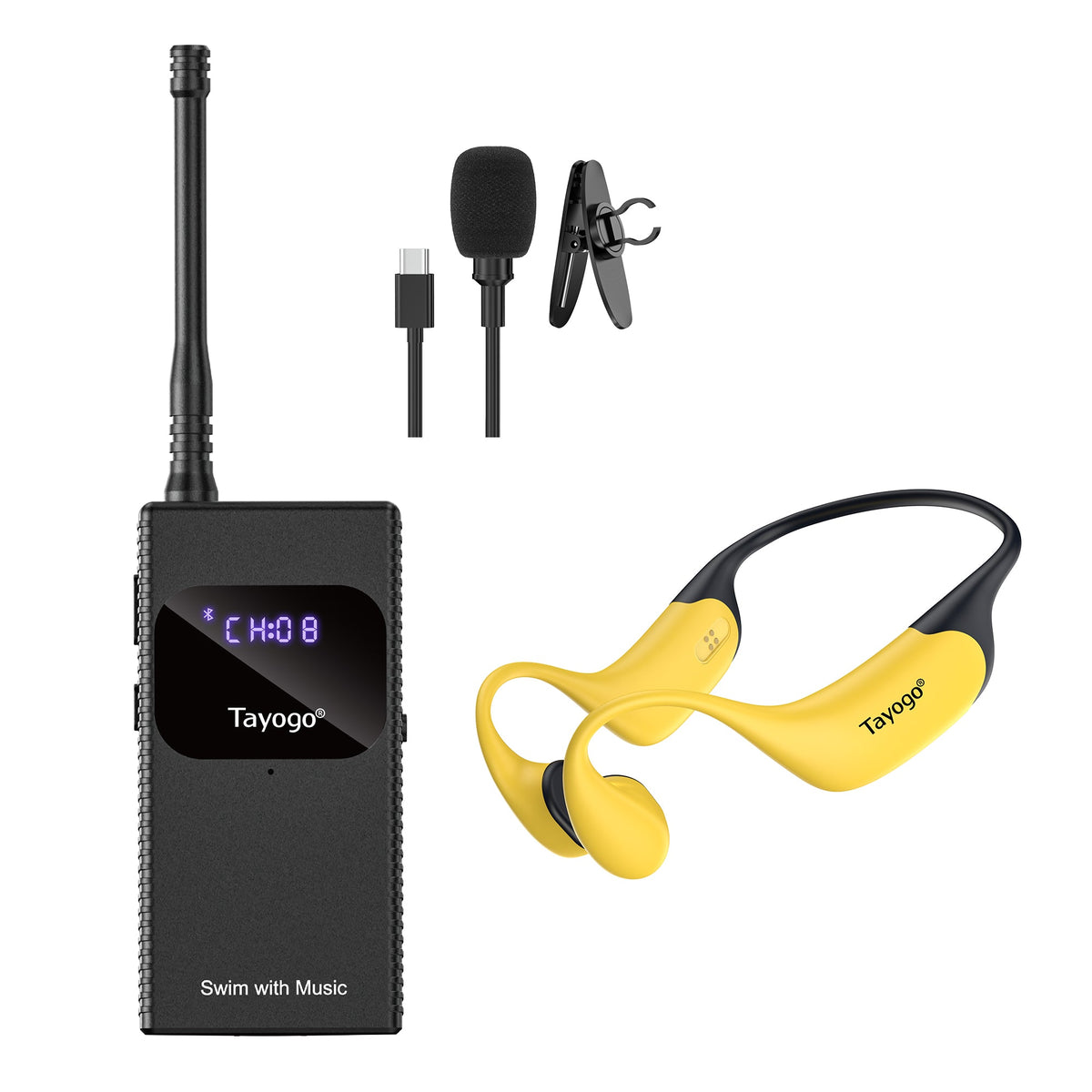
The artistic swimming kit pairs a dry poolside T6 transmitter with W23 bone-conduction receivers worn by athletes.
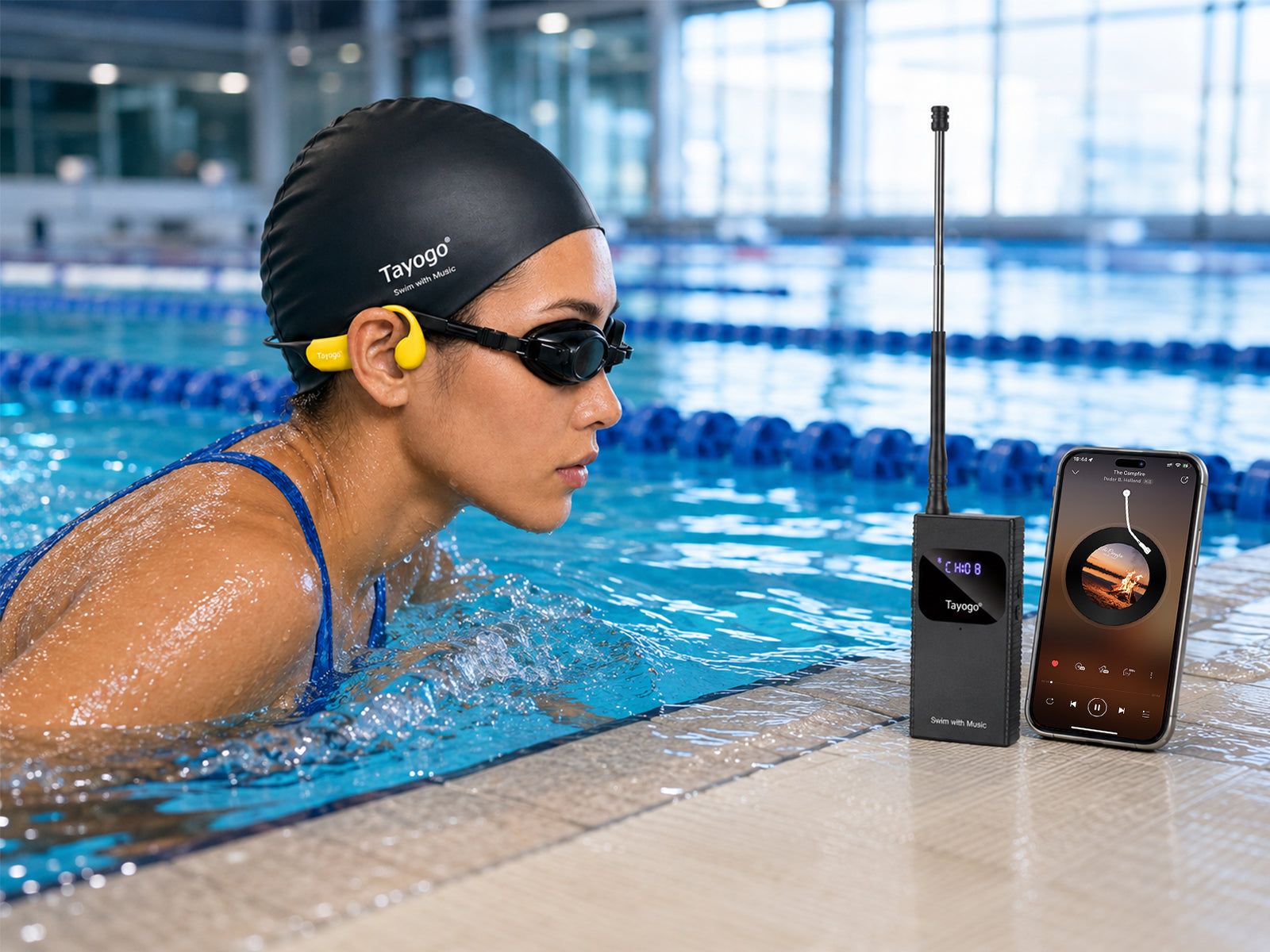
Poolside: T6 mixes phone music and coach voice
- Place the T6 dry and upright beside the pool, antenna fully extended.
- Connect the phone to T6 by Bluetooth (this link stays above water).
- Connect the coach microphone to T6.
- Put each W23 in Receiving Mode and match the T6 channel.
T6 mixes phone audio with the microphone and sends both as one feed. Athletes hear the routine and live cues together—counts, “hold,” height notes, formation calls—without stopping playback.
In the water: FM to the team, not underwater Bluetooth
A common misconception is that phone Bluetooth somehow “works underwater.” In this system it does not. Bluetooth connects the phone to the dry T6. T6 uses FM transmission to the swimmers’ headphones; the underwater link is not Bluetooth. That distinction matters when clubs compare consumer earbuds to a dedicated artistic swimming audio system.
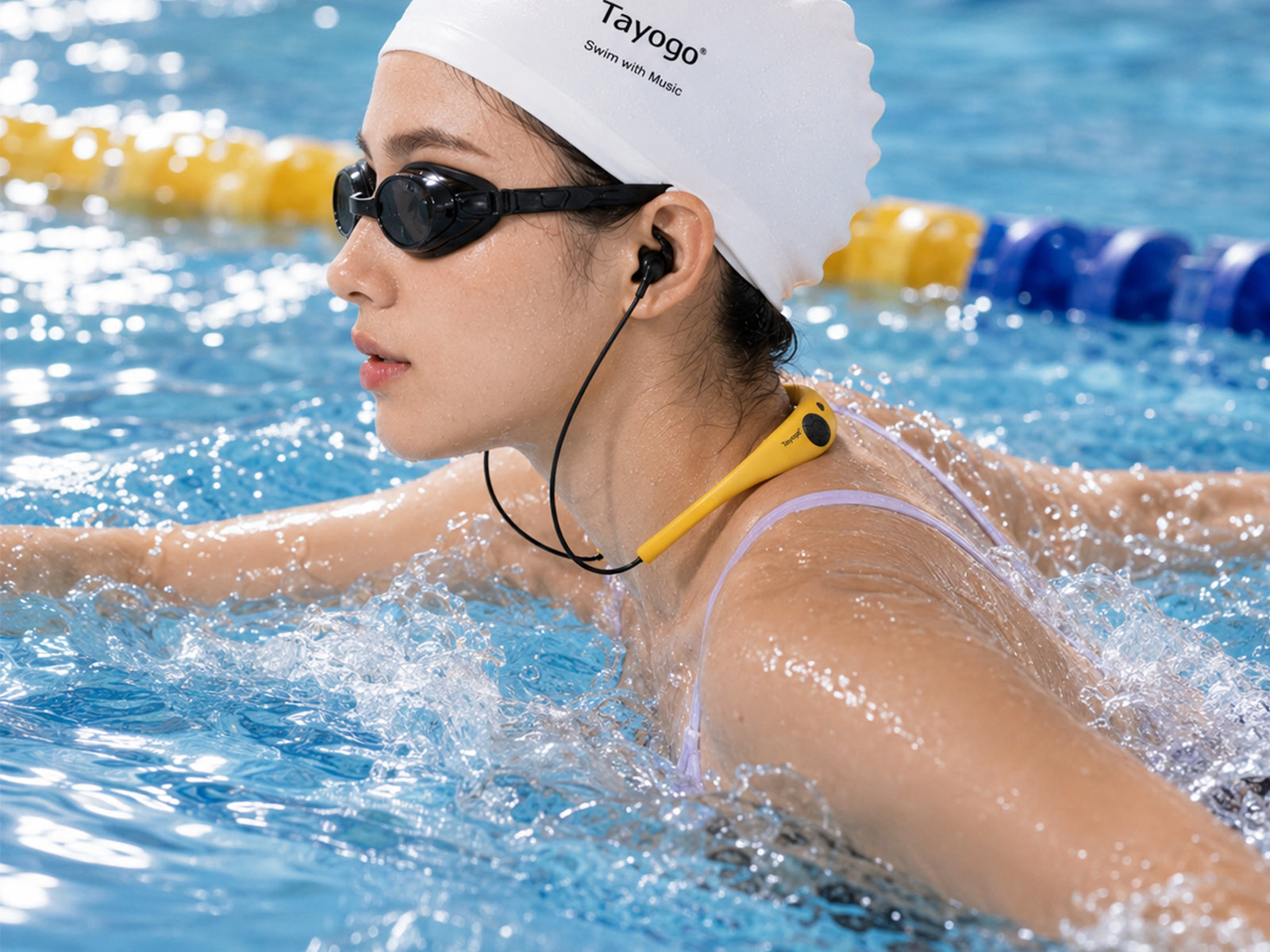
W23: open-ear receive with a silicone overmold neckband
W23 is a waterproof bone-conduction receiver with a flexible silicone overmold neckband designed to sit securely under a cap during choreography. Modes on the artistic Swim Combo W23 include:
- Training receive — hear T6 music + coach on the same channel
- Bluetooth — everyday open-ear listening out of the water
- Local FM — tune broadcast radio when useful
There is no built-in MP3 memory on this W23 configuration. Play the routine from the phone through T6 so the whole squad stays on one file and one tempo.
Depth specs coaches should read carefully
Product pages sometimes list more than one “depth” number. For planning practices, keep them separate:
| Spec | What it means for practice |
|---|---|
| Underwater audio reception ≥2 m | Strong signal observed at 2 metres in Tayogo testing. Actual reception varies with pool, transmitter placement, and headset position. |
| Waterproof testing ~5 m | W23 waterproof test condition (IPX8). Not a claim that audio reception is proven at 5 metres. |
| T6 placement | Not waterproof. Keep dry beside the pool. |
Before a large order, clubs should test listening positions and routine depths in their pool—shallow figures, mid-depth hybrids, and the spots where athletes actually train.
Channels, one-way coaching, and team scale
16 selectable channels
Set T6 and every W23 to the same channel for a shared team feed. Extra channels help when another group is training nearby or when you need to avoid local interference.
One-way coach-to-athlete audio
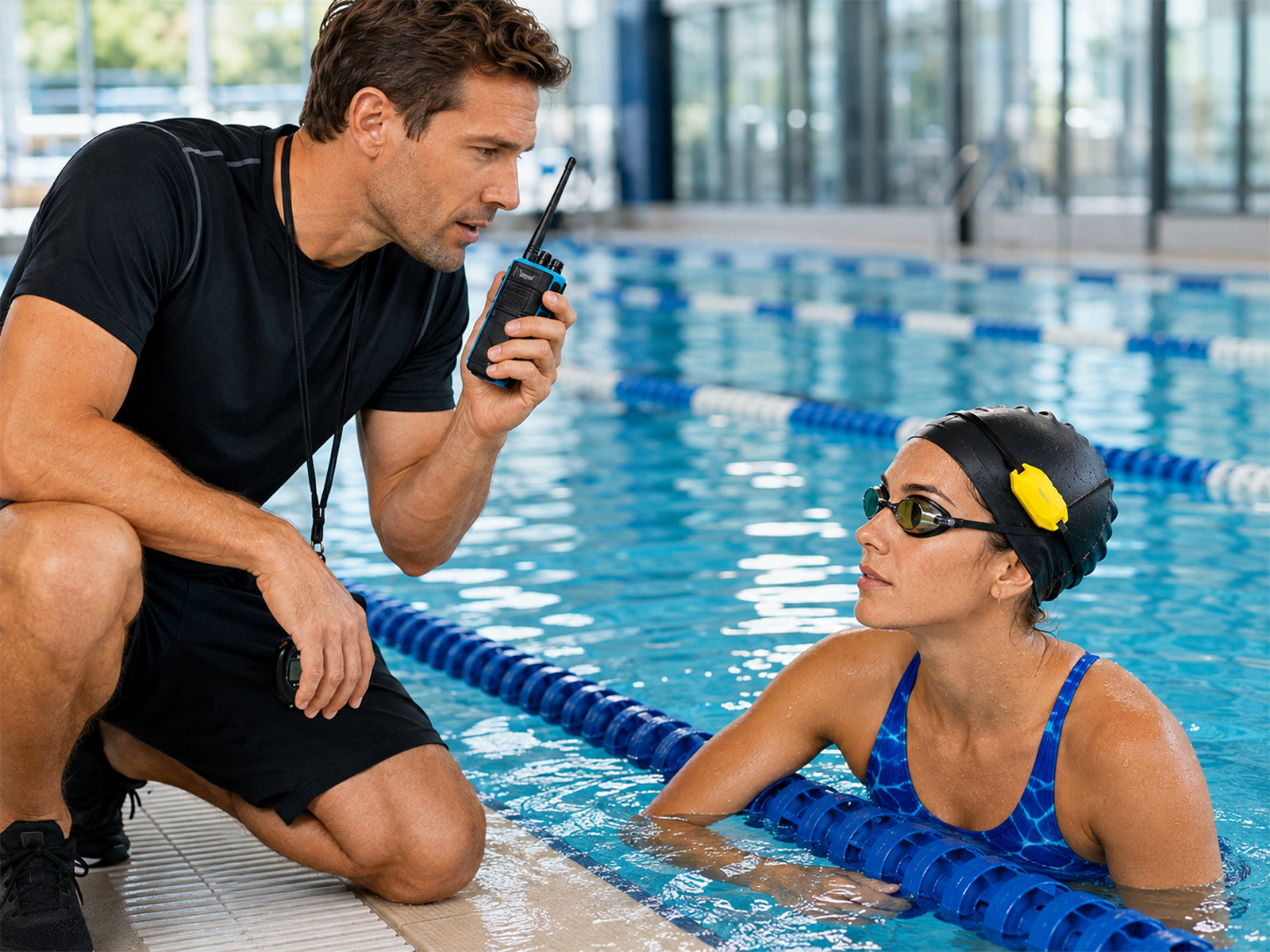
This is not a two-way underwater walkie for athletes talking back. It is a one-way system: coach and music go to the swimmers. That matches how most artistic coaches already run deck feedback—clear, immediate, without asking athletes to reply mid-figure.
Grow from solo to full team
Packages scale with the squad:
- Solo / duet: T6 + 1 or 2 W23
- Team packages: T6 + 5, 10, or 20 W23
- Extra receivers: add compatible W23 units later and match the channel
Entry kits on Shopify start around the T6 + 1× W23 package (see current pricing on the product page). Group kits typically ship mixed colors unless otherwise arranged.
Internal link: T6 + W23 Artistic Swimming Audio System
Artistic kit vs. music-only swim combos vs. voice-only coach systems
U.S. clubs often ask which Tayogo line fits which session. A practical split:
Choose the artistic T6 + W23 when you need music and coaching together
Best for routine run-throughs, hybrid timing, and any block where stopping the track to talk costs more than the correction is worth.
Internal link: product handle tayogo-t6-w23-artistic-swimming-audio-system-music-coach-voice-mixer
Choose a T6 music combo when athletes mainly need phone audio underwater
Spotify, Audible, or pacing tracks for lap or technique work without a coach mic mix. Example handle: tayogo-t6-w23-aquasonic-elite-underwater-streaming-headphones-combo.
Choose a dedicated coach communicator when voice range matters more than music
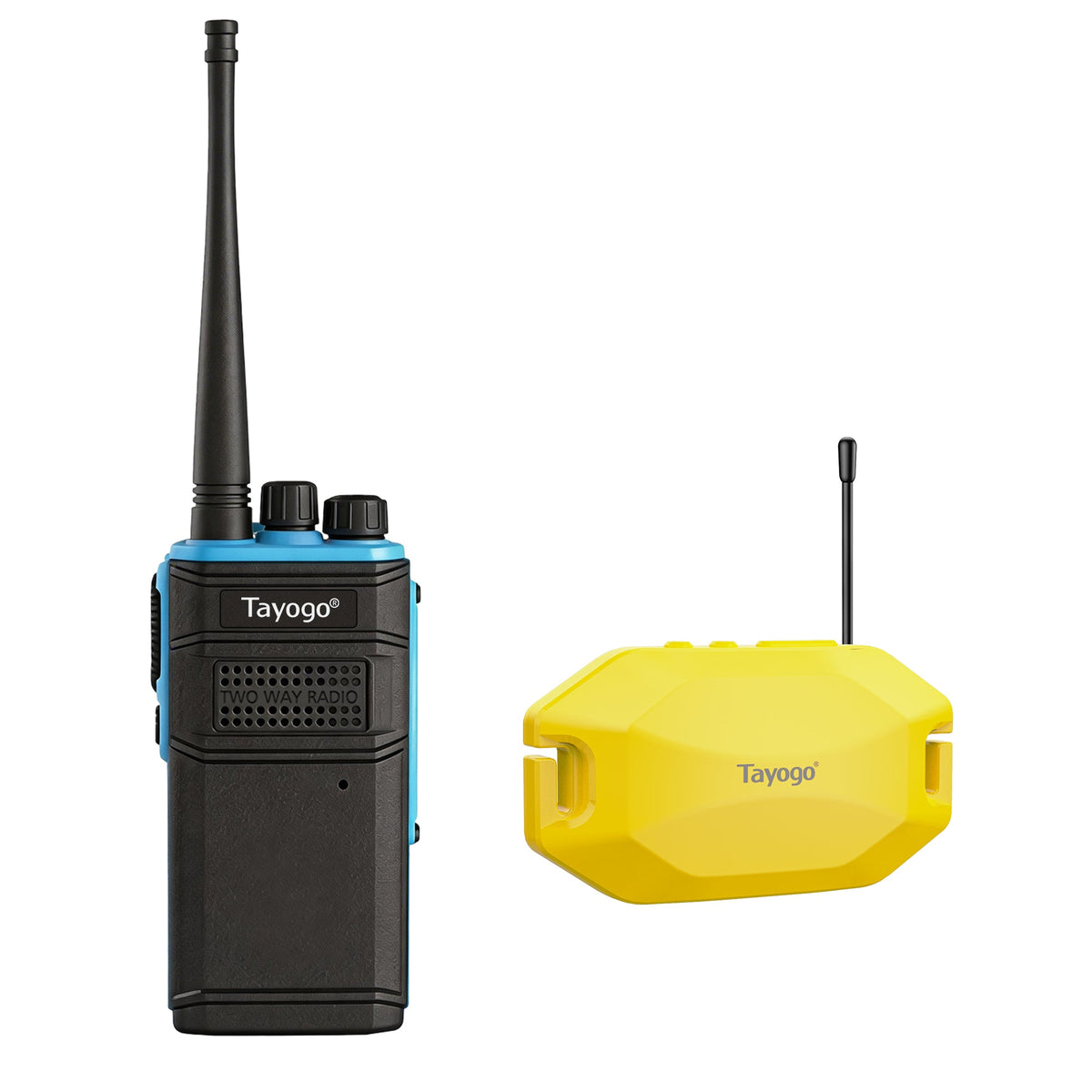
For stroke coaching across a crowded pool or open-water spacing—without streaming a routine—look at long-range voice systems such as the T8 + W24T line (handle tayogo-t8-w24t-swim-coach-communicator-real-time-walkie-talkie-bone-conduction-underwater-audio-system) or the T6 coach communicator (handle tayogo-t6-w23-swim-coach-communicator-system). Those prioritize live voice instruction; they are not a substitute for artistic music-plus-cue practice.
Poolside habits that improve every session
Small setup habits matter more than most feature lists:
- Extend the antenna and keep T6 upright. Incomplete antenna extension is a common source of static.
- Keep T6 dry. Splashes happen; plan a stable deck position away from the gutter.
- Match channels before the whistle. Thirty seconds of channel check saves a wasted first run.
- Use the included waterproof earplugs when water noise competes with the track. Bone conduction stays open-ear; plugs can make the feed cleaner underwater.
- Charge between heavy blocks. Transmitters and receivers both need a routine maintenance habit, just like pace clocks.
Open-air range for the T6 system is listed up to approximately 150 m in open conditions. That is not an underwater range specification. Plan around your deck layout and the depths you actually train.
What a typical artistic practice block looks like with mixed audio


Warm-up / land drill: Athletes may use W23 Bluetooth on deck for a warm-up playlist, then switch to Receiving Mode at the wall.
Figure focus: Coach mic only or low music volume—still one channel, still no shouting across the glass.
Routine run: Full track from the phone through T6; coach drops counts and “hit” cues without pausing Spotify or the exported routine file.
Duet / team split: One T6 feed for the group; add receivers as athletes rotate in. No new music library per headset.
This workflow is why clubs describe the kit as a music and coach voice mixer rather than “just another swimming headphone.”
Buying checklist for U.S. clubs and coaches
Before you expand to a 10- or 20-receiver package, write down:
- Swimmer count for peak practice (not just competition roster)
- Pool length / outdoor vs. indoor, and typical routine depths
- Whether you need music + voice, voice only, or music only
- Who owns the phone that holds the official routine file
- Charging and storage plan (case, cables, overnight charge)
Then email or contact support with those details if you want help sizing a kit. Soft trial thinking beats a full-team order that sits unused because placement was never tested.
Soft next step
If your program is ready to keep music and coaching on one underwater feed, review package sizes and current options on the artistic product page, then start with a solo or duet kit to validate reception in your pool before scaling.
View the kit: Tayogo T6 + W23 Artistic Swimming Audio System
Related reading placeholders:
- Coach voice focus: /products/tayogo-t8-w24t-swim-coach-communicator-real-time-walkie-talkie-bone-conduction-underwater-audio-system
- T6 coach FM system: /products/tayogo-t6-w23-swim-coach-communicator-system
- T6 transmitter overview: /products/t6
FAQ
Can swimmers hear music and the coach at the same time?
Yes. T6 mixes phone audio with the coach microphone and transmits both to W23 receivers on the same channel. You do not need to pause the routine to give a cue.
Does Bluetooth work underwater with this system?
No. Bluetooth links the phone to the dry T6. Underwater delivery to the headsets is via FM receive—not underwater Bluetooth.
Is the 5-metre number audio reception?
No. Approximately 5 metres refers to waterproof testing. Stated underwater reception depth is ≥2 metres, with strong signal observed at 2 metres in Tayogo testing. Performance varies by pool and setup.
Can athletes talk back to the coach?
No. This is a one-way coach-to-swimmer audio system.
Do we load MP3 files onto each W23?
No. The artistic Swim Combo W23 has no built-in MP3 memory. Play the routine from your phone through T6 so the whole team shares one source.
Can we add more receivers later?
Yes. Add compatible W23 receivers, match the T6 channel, and expand from solo practice to larger team packages (including 5 / 10 / 20). Confirm receiver version with support if you already own older hardware.
What should we check before a club-wide order?
Test reception at the positions and depths you use in routines. Share pool dimensions, training depth, and headcount when asking for a recommended kit size.